
FTAsiaEconomy technology updates cover the latest developments in artificial intelligence, fintech, blockchain, cybersecurity, cloud computing, digital payments, green technology, and digital transformation across Asia.
These updates are important because Asia has become one of the strongest technology regions in the world. From China’s growth in artificial intelligence and electric vehicles to Taiwan’s leadership in semiconductor manufacturing, India’s digital payment revolution, Japan’s robotics industry, and Singapore’s smart city innovation, technology across Asia is shaping global markets.
For business owners, investors, students, professionals, entrepreneurs, and everyday readers, staying updated is no longer optional. Technology now affects how people work, study, shop, invest, communicate, and protect their data online.
This guide explains what FTAsiaEconomy technology updates include, why they matter, which technologies are growing fastest, how different industries are being transformed, and what future trends may shape Asia’s digital economy through 2030.
Quick Summary
FTAsiaEconomy technology updates focus on major technology trends across Asia and global markets. These updates commonly cover artificial intelligence, fintech, blockchain, cybersecurity, cloud computing, e-commerce, smart cities, robotics, green technology, and digital payments.
The main value of these updates is that they help readers understand not only what is happening in technology, but also why it matters for businesses, careers, investments, industries, and daily life.
What Are FTAsiaEconomy Technology Updates?
FTAsiaEconomy technology updates refer to news, insights, market trends, and analysis related to new and emerging technologies, especially those influencing Asia’s fast-growing digital economy.
These updates may include information about:
- Artificial Intelligence
- Financial Technology
- Blockchain
- Cybersecurity
- Cloud Computing
- E-commerce
- Digital Payments
- Smart Cities
- Green Technology
- Robotics
- Internet of Things
- Semiconductors
- Startup Innovation
- Government Technology Policies
- Digital Transformation
The purpose of these updates is to help readers understand how technology is changing businesses, economies, industries, and consumer behavior.
Instead of only listing new tools or headlines, strong technology updates explain the practical impact behind each trend.
Why Technology Updates Matter Today
Technology is no longer changing slowly. New tools, platforms, and systems are appearing every month.
A business that ignores new technology may lose customers, waste time, or fall behind competitors. A student who understands emerging trends can prepare for better career opportunities. An investor who follows technology updates can identify growing industries before they become mainstream.
Following reliable technology updates helps readers:
- Understand new business opportunities
- Learn about digital products and tools
- Follow AI and automation trends
- Stay aware of cybersecurity risks
- Discover startup innovation
- Understand future job markets
- Track government technology policies
- Make smarter financial and professional decisions
Knowledge has become a competitive advantage. People who understand technology early are usually better prepared for future changes.
Why Asia Is Important in Global Technology
Asia is one of the most important regions in the global technology economy. Many Asian countries are leading in areas such as artificial intelligence, fintech, robotics, semiconductors, electric vehicles, smart cities, and digital payments.
| Country | Major Technology Strength |
| China | Artificial intelligence, electric vehicles, e-commerce, fintech |
| Japan | Robotics, automation, healthcare technology |
| South Korea | Semiconductors, electronics, 5G, display technology |
| India | Software development, digital payments, startups |
| Singapore | Fintech, smart cities, cybersecurity, digital governance |
| Taiwan | Advanced semiconductor manufacturing |
| Indonesia | Digital payments, e-commerce, startup growth |
| Vietnam | Manufacturing technology, electronics, digital services |
This is why FTAsiaEconomy tech updates are useful for readers who want to understand not only Asian markets, but also global technology direction.
When Asia adopts or develops a major technology, the effect is often felt worldwide.
Major Technologies Covered by FTAsiaEconomy Technology Updates
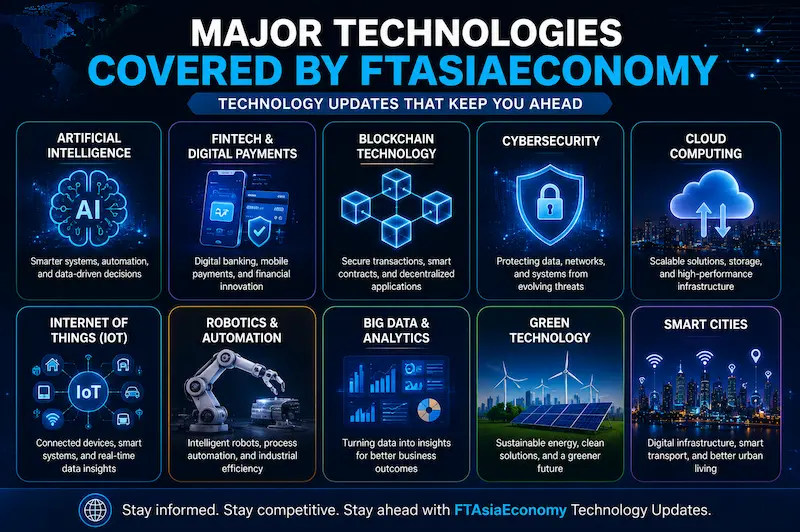
FTAsiaEconomy technology updates usually cover several fast-growing technology sectors. Each one plays a different role in shaping the future of business, work, finance, and society.
Artificial Intelligence
Artificial Intelligence is one of the most powerful technology trends in the world.
AI is now used in:
- Customer service
- Healthcare
- Banking
- Education
- Marketing
- Cybersecurity
- Retail
- Manufacturing
- Software development
- Data analysis
Modern AI tools can generate content, analyze large amounts of data, detect fraud, translate languages, assist doctors, improve search results, and automate repetitive tasks.
Businesses use AI to save time, reduce costs, improve productivity, and deliver better customer experiences.
Examples of AI in Daily Life
AI is already present in many common services, including:
- Chatbots answering customer questions
- Banks detecting suspicious transactions
- E-commerce websites recommending products
- Healthcare systems analyzing medical images
- Translation apps converting languages
- Search engines improving results
- Navigation apps suggesting faster routes
AI is not only a future technology. It is already part of daily life.
Generative AI
Generative AI has become one of the most important parts of modern artificial intelligence.
Unlike traditional AI systems that mainly analyze information, generative AI can create new content such as:
- Articles
- Images
- Videos
- Music
- Presentations
- Marketing copy
- Product descriptions
- Computer code
- Business reports
This technology is helping businesses create content faster, support customers more efficiently, and improve creative workflows.
However, the best results usually come when humans use AI as an assistant rather than relying on it completely. Human judgment, editing, strategy, and creativity still matter.
AI Agents
AI agents are another emerging trend worth watching.
Unlike simple chatbots, AI agents can complete multi-step tasks with less human input. They may help with:
- Scheduling meetings
- Managing emails
- Researching topics
- Creating reports
- Monitoring markets
- Handling customer requests
- Organizing business workflows
- Analyzing company data
AI agents could become common workplace assistants in the coming years. Businesses that learn how to use them early may gain a strong productivity advantage.
Financial Technology
Financial technology, also known as fintech, is one of Asia’s strongest digital sectors.
Fintech is changing how people save, send, borrow, invest, and manage money.
Common fintech services include:
- Mobile banking
- Digital wallets
- Online money transfers
- Investment apps
- Digital lending
- Buy now, pay later services
- Online insurance
- Contactless payments
- Business payment gateways
Across Asia, millions of people now use smartphones for financial services that previously required physical bank visits.
For businesses, fintech improves payment speed, reduces transaction friction, and makes online sales easier.
Digital Payments
Digital payments are replacing cash in many Asian markets.
Consumers now use mobile apps to:
- Pay bills
- Buy groceries
- Shop online
- Send money to family
- Book travel
- Pay restaurant bills
- Recharge mobile accounts
- Purchase subscriptions
Digital payments are popular because they are fast, convenient, and easy to track.
For small businesses, digital payment systems can improve customer experience and reduce cash-handling problems.
Blockchain Technology
Many people still connect blockchain only with cryptocurrency, but blockchain has wider use cases.
Blockchain can help organizations:
- Secure digital records
- Verify identities
- Track supply chains
- Reduce fraud
- Protect medical data
- Improve financial transparency
- Confirm product authenticity
- Support smart contracts
Industries such as finance, healthcare, logistics, real estate, and manufacturing are exploring blockchain for security and transparency.
Blockchain adoption is still developing, but its long-term potential remains important.
Cybersecurity
As more people and businesses move online, cybersecurity has become essential.
Cyber threats can affect individuals, companies, banks, hospitals, schools, and government systems.
Common cybersecurity risks include:
- Phishing emails
- Ransomware
- Identity theft
- Fake investment scams
- Malware
- Data breaches
- Password attacks
- Social engineering
Technology updates often highlight cybersecurity because digital progress also creates new risks.
Basic Cybersecurity Practices
Everyone should follow simple safety habits, such as:
- Use strong and unique passwords
- Enable two-factor authentication
- Avoid suspicious links
- Update software regularly
- Back up important files
- Verify unknown emails
- Use trusted security tools
- Avoid sharing sensitive information publicly
Cybersecurity is not only an IT department’s responsibility. Every internet user plays a role in staying safe online.
Cloud Computing
Cloud computing allows businesses to store data, run software, and access computing power through the internet instead of relying only on physical servers.
Cloud technology helps companies with:
- File storage
- Remote work
- Team collaboration
- Data backup
- Software deployment
- Customer management
- Project management
- Disaster recovery
Cloud services are useful for both large companies and small businesses because they reduce infrastructure costs and improve flexibility.
Remote and hybrid work have also made cloud computing more important than ever.
E-commerce Technology
E-commerce continues to expand across Asia.
Online shopping platforms now use advanced technology to improve customer experience and business performance.
Important e-commerce technologies include:
- AI product recommendations
- Digital payments
- Chatbots
- Smart inventory systems
- Faster delivery tracking
- Personalized marketing
- Augmented reality product previews
- Automated customer support
Businesses that understand e-commerce technology can reach more customers and compete more effectively.
Smart Cities
Smart cities use technology to improve urban life.
Examples of smart city technologies include:
- Intelligent traffic systems
- Smart parking
- Digital government services
- Energy-efficient buildings
- Connected public transport
- Smart waste management
- AI-powered monitoring
- Real-time environmental tracking
Several Asian cities are investing in smart infrastructure to reduce traffic, save energy, improve public services, and support safer communities.
Smart cities are expected to grow as urban populations increase.
Green Technology
Green technology is becoming a major part of economic growth.
Governments and companies are investing in sustainable solutions because climate change, energy costs, and environmental concerns are becoming more serious.
Green technology includes:
- Solar energy
- Wind power
- Electric vehicles
- Smart energy grids
- Energy-efficient buildings
- Carbon reduction systems
- Sustainable manufacturing
- Recycling technology
- Eco-friendly construction
Green technology is not only good for the environment. It is also creating new industries, jobs, and investment opportunities.
Internet of Things
The Internet of Things, or IoT, connects physical devices to the internet so they can collect and share data.
Examples include:
- Smart home devices
- Fitness trackers
- Connected vehicles
- Industrial sensors
- Smart agriculture tools
- Remote health monitors
- Smart factory equipment
IoT helps businesses improve efficiency and helps consumers enjoy greater convenience.
As more devices become connected, IoT will become more important in homes, cities, factories, healthcare, and transportation.
Robotics and Automation
Robotics and automation are transforming workplaces across Asia.
Robots are now used in:
- Manufacturing
- Warehousing
- Healthcare
- Agriculture
- Logistics
- Retail
- Food production
- Elderly care
Automation helps companies increase speed, improve accuracy, reduce errors, and lower costs.
However, automation does not mean every job will disappear. Many jobs will change, and new careers will appear in robotics, AI management, data analysis, system maintenance, and digital operations.
Semiconductor Technology
Semiconductors are the foundation of modern technology.
They power:
- Smartphones
- Computers
- Electric vehicles
- AI systems
- Data centers
- Home appliances
- Medical devices
- Gaming consoles
- Industrial machines
Asia plays a major role in semiconductor production, especially through countries and regions such as Taiwan, South Korea, Japan, and China.
Because chips are essential for modern technology, semiconductor updates are important for businesses, investors, and global markets.
How FTAsiaEconomy Technology Updates Help Different Readers
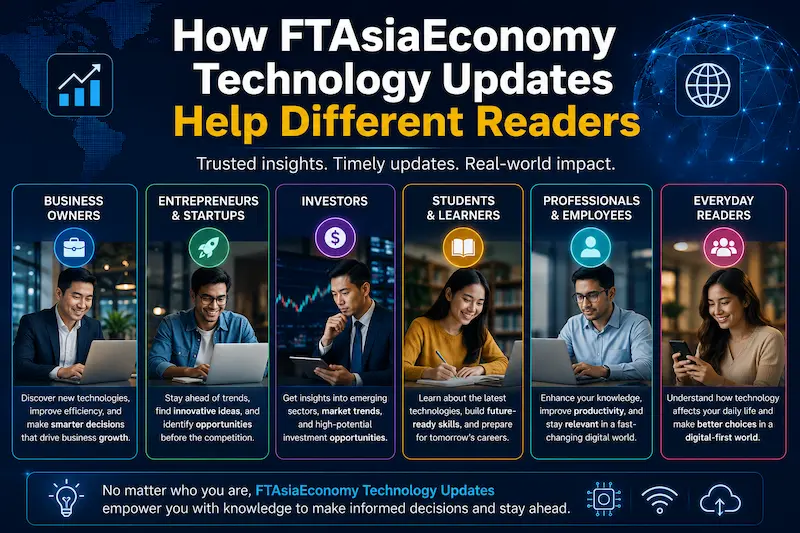
One reason FTAsiaEconomy technology updates are valuable is that they help different types of readers in different ways.
For Business Owners
Business owners can use technology updates to understand new tools, improve operations, reduce costs, and serve customers better.
For example, a small business may use:
- Digital payments for faster transactions
- AI chatbots for customer support
- Cloud tools for file sharing
- E-commerce platforms for online sales
- Cybersecurity tools for protection
Technology can help small businesses compete with larger companies.
For Entrepreneurs
Entrepreneurs can use technology updates to discover new startup ideas and market gaps.
Emerging areas such as AI, fintech, healthtech, green technology, cybersecurity, and e-commerce may create strong opportunities for new businesses.
For Investors
Investors follow technology trends to understand which industries are growing.
Technology updates can help investors identify sectors with long-term potential, such as:
- Artificial intelligence
- Semiconductors
- Cybersecurity
- Renewable energy
- Digital payments
- Cloud computing
- Electric vehicles
- Automation
Good technology knowledge can support better investment research.
For Students
Students can use technology updates to prepare for future careers.
Understanding AI, data, cybersecurity, cloud computing, and digital tools can help students choose better skills and career paths.
For Professionals
Working professionals need to stay updated because many industries are changing quickly.
Professionals who learn new digital skills are more likely to stay competitive in the job market.
Useful skills include:
- AI literacy
- Data analysis
- Cybersecurity awareness
- Cloud computing basics
- Digital communication
- Programming fundamentals
- Automation tools
- Critical thinking
Industry-Wise Impact of Technology
Technology does not affect only the IT sector. Almost every industry now depends on digital tools.
Healthcare
Healthcare is becoming smarter through digital transformation.
Important healthcare technologies include:
- Telemedicine
- Electronic health records
- AI-assisted diagnosis
- Remote patient monitoring
- Wearable health devices
- Robotic-assisted surgery
- Digital appointment systems
These tools can improve patient care, reduce waiting times, and help doctors make faster decisions.
Education
Education has become more accessible because of digital tools.
Technology in education includes:
- Online classes
- AI learning platforms
- Digital textbooks
- Virtual laboratories
- Language learning apps
- Online certifications
- Personalized learning systems
Students can now learn from anywhere, while teachers can use technology to track progress and create better lessons.
Retail
Retail businesses use technology to improve sales and customer experience.
Examples include:
- Online stores
- AI recommendations
- Customer support chatbots
- Smart inventory systems
- Digital loyalty programs
- Fast delivery tracking
- Augmented reality previews
Retailers that adopt technology can better understand customers and increase satisfaction.
Agriculture
Agriculture is becoming more intelligent with digital tools.
Smart agriculture includes:
- Drone monitoring
- Soil sensors
- Weather forecasting tools
- Smart irrigation
- AI crop analysis
- GPS-guided machinery
These technologies help farmers increase production, save water, reduce waste, and make better decisions.
Manufacturing
Manufacturing is entering the Industry 4.0 era.
Modern factories use:
- Robotics
- Artificial intelligence
- Internet of Things
- Cloud computing
- Big data
- Predictive maintenance
Benefits include faster production, better quality control, lower downtime, and improved efficiency.
Transportation
Transportation technology is improving how people and goods move.
Important trends include:
- Electric vehicles
- Smart traffic systems
- GPS optimization
- Digital ticketing
- Ride-sharing platforms
- AI route planning
- Autonomous vehicle research
These technologies can reduce travel time, improve safety, and lower fuel consumption.
High-Demand Technology Careers
Following FTAsiaEconomy technology updates can also help readers understand which careers are growing.
| Career | Why It Is Growing |
| AI Engineer | Businesses need intelligent systems and automation |
| Data Scientist | Companies need insights from large datasets |
| Cybersecurity Analyst | Digital threats are increasing |
| Cloud Engineer | More businesses are moving to cloud platforms |
| Blockchain Developer | Secure digital systems are expanding |
| Robotics Engineer | Automation is growing in many industries |
| UX Designer | Digital products need better user experiences |
| DevOps Engineer | Software teams need faster deployment systems |
| Digital Marketing Specialist | Online business growth requires digital promotion |
| IoT Specialist | Connected devices are expanding |
Students and professionals who build these skills may have stronger career opportunities in the future.
Emerging Technologies Worth Watching
While AI receives much attention, several other technologies may also shape the future.
Quantum Computing
Quantum computing is still developing, but it may eventually solve problems that traditional computers cannot handle efficiently.
Possible uses include:
- Drug discovery
- Financial modeling
- Advanced encryption
- Scientific research
- Complex simulations
Extended Reality
Extended Reality includes virtual reality, augmented reality, and mixed reality.
It can be used in:
- Gaming
- Education
- Employee training
- Healthcare simulations
- Virtual shopping
- Product demonstrations
As devices become better and more affordable, extended reality may become more common.
Edge Computing
Edge computing processes data closer to where it is created instead of sending everything to distant cloud servers.
It is useful for:
- Smart cities
- Autonomous vehicles
- Industrial automation
- Healthcare devices
- Security systems
- IoT networks
Edge computing can reduce delays and improve real-time decision-making.
Challenges Technology Still Faces
Technology brings many benefits, but it also creates challenges.
Data Privacy
People want more control over their personal information. Businesses must handle user data responsibly and follow privacy rules.
Digital Divide
Not everyone has equal access to fast internet, modern devices, or digital education. This gap can limit opportunities for people in rural or low-income areas.
AI Ethics
AI creates important questions about bias, copyright, misinformation, transparency, and human oversight.
Responsible AI development is necessary to protect users and build trust.
Job Transformation
Automation can change job requirements. Some repetitive tasks may disappear, but new roles will also emerge.
The best solution is continuous learning and skill development.
Misinformation
Technology makes information easier to share, but it also makes false information spread faster.
Readers need reliable sources and critical thinking skills to separate facts from hype.
Future of FTAsiaEconomy Technology Updates Through 2030
Technology will continue changing how people work, communicate, study, travel, shop, and receive healthcare.
Here are some major trends to watch.
1. AI Will Become a Daily Assistant
AI will become more common in offices, schools, homes, and businesses.
It may help people write reports, organize schedules, analyze information, plan travel, manage customer support, and improve productivity.
2. Digital Payments Will Keep Expanding
Cashless payments will continue growing across Asia.
More consumers and businesses will use mobile wallets, online banking, payment apps, and instant transfer systems.
3. Smart Cities Will Grow
Cities will use more technology to manage traffic, energy, waste, public transport, and emergency services.
Smart infrastructure may become a major part of urban planning.
4. Green Technology Will Become More Important
Clean energy, electric vehicles, smart grids, and sustainable manufacturing will continue growing as governments and companies focus on environmental goals.
5. Healthcare Will Become More Personalized
AI, wearable devices, remote monitoring, and digital health records may help doctors provide more personalized care.
6. Cybersecurity Will Become More Advanced
As cyber threats increase, organizations will use AI-powered security tools, stronger identity verification, and better data protection systems.
Technology Trends at a Glance
| Technology | Current Impact | Future Outlook |
| Artificial Intelligence | Automation and data analysis | Daily AI assistants |
| Fintech | Mobile banking and digital payments | Fully digital financial services |
| Blockchain | Secure records and transactions | Digital identity and supply chains |
| Cloud Computing | Remote work and collaboration | Smarter cloud platforms |
| Cybersecurity | Data and system protection | AI-powered threat detection |
| IoT | Smart homes and factories | Connected cities and industries |
| Robotics | Manufacturing automation | Healthcare, logistics, and service robots |
| Green Technology | Renewable energy adoption | Sustainable smart infrastructure |
| Semiconductors | Powering modern devices | Advanced AI and EV growth |
Common Myths About Technology Updates
Myth 1: Technology Updates Are Only for IT Experts
Reality: Business owners, students, teachers, investors, professionals, and everyday users can all benefit from technology updates.
Myth 2: AI Will Replace Every Job
Reality: AI will change many jobs, but it will also create new opportunities. Human creativity, communication, judgment, and problem-solving will remain important.
Myth 3: Technology Only Helps Large Companies
Reality: Small businesses often benefit from affordable digital tools such as online payments, social media marketing, cloud software, and AI customer support.
Myth 4: Cybersecurity Is Only for Big Businesses
Reality: Individuals and small businesses are also common targets for scams, phishing, and data theft.
Myth 5: Every New Trend Is Worth Following
Reality: Not every trend becomes successful. Reliable updates help readers understand which technologies have real long-term value.
How Businesses Can Stay Ahead
Businesses can stay competitive by using technology strategically.
Practical steps include:
- Monitor technology trends regularly
- Train employees in digital skills
- Use cloud-based tools where useful
- Improve cybersecurity policies
- Use data for decision-making
- Test new tools before competitors
- Focus on customer needs
- Avoid adopting technology without a clear purpose
Technology should solve real problems. It should not be used only because it is new.
How Students Can Prepare for the Future
Students should build skills that match future job markets.
Important areas include:
- Artificial intelligence basics
- Data analysis
- Cybersecurity awareness
- Cloud computing
- Digital marketing
- Programming
- Communication
- Critical thinking
- Problem-solving
- Adaptability
Technical skills are important, but soft skills will also remain valuable.
What Makes Reliable Technology Information Valuable?
The internet is full of dramatic headlines about new technology. However, not every headline gives the full picture.
Reliable technology information should:
- Explain concepts clearly
- Show practical examples
- Discuss benefits and risks
- Avoid exaggerated claims
- Separate facts from speculation
- Focus on long-term impact
- Help readers make informed decisions
This is why balanced technology updates are more useful than hype-based content.
Frequently Asked Questions
What are FTAsiaEconomy technology updates?
FTAsiaEconomy technology updates are news, insights, and analysis about emerging technologies such as artificial intelligence, fintech, blockchain, cybersecurity, cloud computing, digital payments, green technology, and smart cities, especially across Asia’s technology economy.
Why are FTAsiaEconomy technology updates important?
They help readers understand how new technologies affect businesses, careers, investments, industries, and everyday life. They also help people prepare for future digital changes.
Who should follow these technology updates?
Business owners, entrepreneurs, investors, students, researchers, professionals, and general readers can all benefit from following technology updates.
Why is Asia important in global technology?
Asia is home to major technology leaders in artificial intelligence, semiconductors, robotics, fintech, digital payments, e-commerce, and smart city development. Innovations from Asia often influence global markets.
Which technologies are growing fastest?
Some of the fastest-growing technologies include artificial intelligence, fintech, cybersecurity, cloud computing, blockchain, digital payments, robotics, green technology, and the Internet of Things.
Can small businesses benefit from technology updates?
Yes. Small businesses can use technology updates to discover affordable tools for online sales, digital payments, customer service, cybersecurity, automation, and marketing.
Why is cybersecurity becoming more important?
Cybersecurity is important because more personal, business, and financial activities now happen online. As digital activity increases, threats such as phishing, ransomware, identity theft, and data breaches also increase.
What skills are useful for the future?
Useful future skills include AI literacy, data analysis, cybersecurity awareness, cloud computing, programming, digital marketing, problem-solving, communication, and adaptability.
Are technology updates only useful for professionals?
No. Technology updates are useful for anyone who wants to understand how digital tools affect money, work, education, shopping, security, communication, and daily life.
What is the future of technology in Asia?
Asia is expected to continue growing in artificial intelligence, fintech, semiconductors, smart cities, green technology, robotics, digital payments, and advanced manufacturing through 2030.
Final Thoughts
FTAsiaEconomy technology updates are valuable because technology now influences almost every part of modern life. From artificial intelligence and fintech to cybersecurity, cloud computing, green technology, smart cities, and robotics, digital innovation is changing how people live and work.
Asia plays a major role in this transformation. Countries such as China, Japan, South Korea, India, Singapore, and Taiwan are helping shape global technology trends through innovation, manufacturing, digital finance, automation, and smart infrastructure.
For businesses, these updates can reveal new opportunities. For students, they can guide future career choices. For investors, they can highlight growing sectors. For everyday readers, they can make technology easier to understand and safer to use.
The key is not to chase every new trend blindly. The real value comes from understanding which technologies solve real problems and create long-term impact.
By following reliable FTAsiaEconomy technology updates, readers can stay informed, make smarter decisions, and prepare for a future where digital innovation will continue to shape Asia and the rest of the world.
Key Takeaways
- FTAsiaEconomy technology updates cover major digital trends shaping Asia and global markets.
- Artificial intelligence, fintech, cybersecurity, cloud computing, blockchain, and green technology are among the most important sectors.
- Asia is a global leader in semiconductors, robotics, digital payments, smart cities, and AI development.
- Technology affects healthcare, education, retail, agriculture, manufacturing, transportation, and finance.
- Businesses, students, professionals, investors, and everyday users can all benefit from staying informed.
- Future growth will likely focus on AI assistants, digital payments, smart cities, cybersecurity, green technology, and personalized healthcare.
- Reliable technology updates should explain both opportunities and risks instead of only promoting hype.
